Guide: Smart Procurement & Inventory for Operational Businesses
Year 1 (2025-26)
by Julio Flores
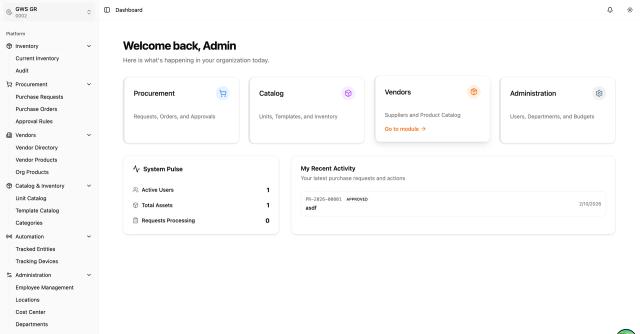
guide-systems.com Is an ERP born at WMU that helps operational companies track inventory, manage purchasing, and connect physical assets to financial accountability — with RFID integration in mind.
About This Idea
Guide began as a senior design opportunity at Western Michigan University. I chose to work on a real problem faced by an operational company that struggled with inventory tracking and visibility across departments.
Initially, the goal was simple: improve inventory tracking.
But inventory does not exist in isolation — it directly impacts purchasing, budgeting, vendor relationships, and financial planning. Once inventory movements were modeled properly, it became clear that procurement and budgeting needed to be part of the same system.
What started as an inventory tracker evolved into a lightweight ERP platform designed specifically for operational service companies.
Guide now connects:
Inventory and asset tracking
Purchase requests and approvals
Vendor management
Budget allocation and cost centers
Receiving and reconciliation workflows
The system is being built with RFID integration in mind, allowing physical assets (like equipment or inventory units) to be digitally tracked and tied directly to financial records.
Instead of fragmented spreadsheets and manual oversight, Guide provides operational clarity and financial accountability in one connected platform.
Where Did This Idea Spark at WMU?
Guide started through my senior design work at WMU.
I wanted to build something meaningful for a real organization, not just complete an academic requirement. While working through the system design, database modeling, and workflow challenges, I realized that inventory management and financial accountability are deeply connected problems.
My career in software architecture, systems design, and database engineering gave me the foundation to build this as a scalable platform rather than a one-off tool.
Impact in Kalamazoo
If successful, Guide can help:
* Local service providers
* Small manufacturers
* Distribution companies
* Facilities and operations teams
These businesses often lack affordable, modern ERP solutions tailored to their scale. Guide can help them:
Reduce inventory loss and shrinkage
Prevent unauthorized or duplicate purchases
Increase transparency in spending
Improve vendor accountability
Digitally track physical assets using RFID
Stronger operational systems help Kalamazoo businesses operate efficiently, reduce waste, and grow sustainably.
How Investment Helps
Funding would allow me to:
Pilot RFID-enabled asset tracking with a local company
Improve hardware integration and testing
Refine the UI for non-technical operational teams
Cover production hosting and infrastructure
The first milestone would be successfully deploying Guide within a local partner organization and completing a full procurement-to-inventory lifecycle — including RFID-based asset tracking.
Without funding, development continues slowly. With funding, Guide can move from technical prototype to deployed solution in Kalamazoo.
What I'll Do With the Money
RFID Hardware & Testing – $5,000
Purchase RFID readers and tags to implement and test real-world asset tracking workflows.
3D Printing Machine & Supplies - $2,000
Purchase a printing machine and filler to create custom RFID guns for easy integration with the system.
Production Infrastructure – $10,000
Secure hosting, backups, and monitoring for pilot deployment.
Business & Pilot Support – $8,000
Legal setup, onboarding materials, and local partnership coordination.
About the Founder
I am a Computer Science student at Western Michigan University specializing in backend architecture and workflow-driven systems.
Guide represents the intersection of technical rigor and practical business needs. I am building it now because I see a clear operational gap in procurement systems for small-to-mid-sized companies — and I have the skills to build a scalable solution from the ground up.