Psychological Flexibility Network Atlas: A New and Improved Mental Health Assessment Approach
Year 1 (2025-26)
by Madison Dirickson
The Psychological Flexibility Network Atlas (PFNA) is a digital tool that maps the processes driving distress, helping clinicians deliver precise, personalized mental health care.
About This Idea
I am building the Psychological Flexibility Network Atlas (PFNA), a digital clinical decision-support platform that transforms how mental health treatment is selected and delivered.
The problem is clear: mental health care is still organized around diagnostic labels that lack biological precision and do not reliably guide intervention selection. Most diagnoses are heterogeneous symptom clusters with high comorbidity, meaning clinicians often rely on trial-and-error when choosing treatments. This results in delayed improvement, unnecessary healthcare costs, clinician frustration, and prolonged client suffering.
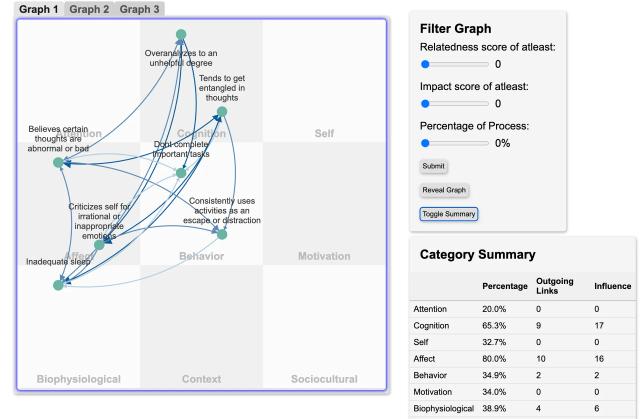
The PFNA addresses this gap by shifting assessment from static symptom categories to dynamic, process-based mapping. Using validated biopsychosocial measures, the PFNA generates a personalized network model that identifies which psychological processes exert the strongest influence within an individual’s system. Rather than asking “What diagnosis does this person meet?” the PFNA asks, “Which modifiable processes are driving distress, and which intervention will most efficiently target them?”
The platform then provides influence scores and evidence-informed intervention matches aligned with the identified high-impact processes. This allows clinicians to make data-driven, mechanism-based treatment decisions.
The PFNA is designed for therapists, integrated health systems, university counseling centers, and digital mental health platforms seeking scalable precision care tools. By operationalizing process-based therapy into a standardized, replicable technology, the PFNA bridges the gap between modern psychological science and real-world clinical practice. This is not another symptom checklist, it is a precision engine for mental health care.
Where Did This Idea Spark at WMU?
The idea for the PFNA sparked during my doctoral training at Western Michigan University. As a PhD student studying clinical psychology and mechanisms of change, I became increasingly aware of the disconnect between how mental health research conceptualizes psychological processes and how clinical practice still relies heavily on diagnostic categories.
Through coursework, supervision, and research training at WMU, I was exposed to process-based therapy, mediation science, and contemporary debates about the limits of the DSM. As I developed my thesis project, I began asking a practical question: If we know that specific biopsychosocial processes drive distress, why don’t we have a standardized way to identify and prioritize them for individual clients?
While working on my thesis, I recognized that clinicians often create network-based case conceptualizations using professional judgment, but there was no structured, scalable, or data-driven system to guide that process.
Impact in Kalamazoo
The PFNA has the potential to significantly improve mental health care delivery in Kalamazoo. By equipping local clinicians, counseling centers, and behavioral health organizations with a data-driven tool for identifying the processes driving distress, the PFNA can help reduce trial-and-error treatment, shorten time to improvement, and increase overall treatment effectiveness. This is especially important in a community where demand for mental health services continues to outpace provider capacity.
By improving precision in care, the PFNA can help maximize limited clinical resources, reduce dropout rates, and improve outcomes for individuals experiencing anxiety, depression, trauma, and related concerns. As the tool is developed locally, it also positions Kalamazoo as a hub for innovation in mental health technology, supporting economic growth, entrepreneurship, and research-to-practice advancement within the region.
How Investment Helps
This investment would allow the PFNA to move from a research prototype to a fully deployable product within Kalamazoo. Funding would directly support advanced software development, including secure infrastructure, user-interface refinement, and scalable data architecture. It would also support business development activities such as legal structuring, intellectual property protection, pilot partnerships with local clinics, and early-stage dissemination planning.
By strengthening both the technological backbone and the commercialization strategy, this investment ensures that the PFNA is not just an academic innovation, but a sustainable, locally rooted mental health technology. Establishing development, testing, and early adoption in Kalamazoo will position the community as a launch site for scalable behavioral health innovation while creating opportunities for local collaboration, workforce development, and long-term economic impact.
What I'll Do With the Money
Software Development & Engineering – $2,500 (50%) – Build and refine the secure, scalable platform infrastructure and user interface for Version 1 deployment.
Data Security & Compliance – $750 (15%) – Implement HIPAA-aligned security protocols, encrypted storage, and secure hosting architecture.
Legal & Intellectual Property – $750 (15%) – Support patent continuation, LLC structuring, and foundational business agreements.
Pilot Implementation & Business Development – $1,000 (20%) – Establish local clinic partnerships, onboarding materials, and early-stage dissemination strategy.
About the Founder
I am a PhD student in clinical psychology at WMU, specializing in process-based therapy. I trained at the University of Nevada, Reno under Steven C. Hayes and earned my master’s in Applied Behavior Analysis from USC, maintaining a 4.0 GPA since sophomore year of undergrad. With thousands of clinical hours, I’ve seen firsthand the need for precise, individualized care, leading me to develop the PFNA from my doctoral research.