With Oneshot AI, Everyone Speaks Your Language
Year 1 (2025-26)
by Samuel Marseille
The healthcare industry's first fully automatic, HIPAA-compliant, medical-grade real-time interpretation system.
About This Idea
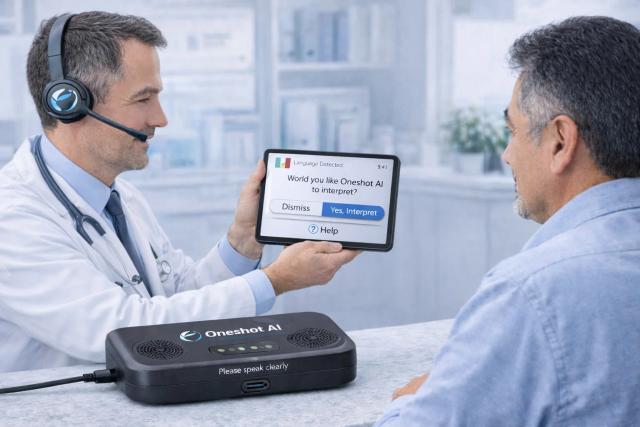
Oneshot AI is an interpretation platform built from the ground up specifically for medical
environments where cultural accuracy matters, compliance is mandatory, and every
second counts. We are engineering a solution that combines intelligent software with
purpose-built hardware to deliver instant, hands-free, bidirectional translation directly in
patient care settings.
Every day in hospitals and clinics, the same scenario plays out hundreds
of times specially across Michigan. A patient arrives speaking Arabic, Swahili, or Burmese. Staff scramble to find interpretation support. Sometimes they wait 15 or more minutes for a phone interpreter.
Sometimes they improvise with family members or staff with limited language skills.
Sometimes they resort to translation apps that weren't designed for medical use and
don't comply with HIPAA requirements.
Our platform runs on smartphones and tablets that your staff already carry. This
architecture choice means rapid deployment without complex hardware procurement
cycles, and it means the system gets smarter over time through software updates rather
than requiring equipment replacement.
The app provides instant bidirectional translation using device microphones and
speakers. A physician asks a question in English, and within one second the patient
hears it in their native language. The patient responds in Spanish or Pashto, and
the physician immediately hears English. The entire interaction flows naturally.
What set our product apart is the Automatic Language Detection system. Our AI engine identifies languages automatically in real-time. Users never select
languages from menus or indicate who's speaking. The system detects English,
Spanish, Arabic, or any supported language instantly and routes translation accordingly.
This automatic operation eliminates the workflow friction that makes other translation
tools feel cumbersome in fast-paced clinical environments.
Where Did This Idea Spark at WMU?
I am building this product because interpretation has been part of my life for more than fifteen years. I became an interpreter at sixteen, built my first translation company at 17, and have worked closely with language access systems ever since. When I first got here in the United States, language barrier was an added challenge to my life even though I could speak English I was still facing difficulties, and I have seen the struggle of too many individuals that have limited English proficiency going to worse, specially in the healthcare. Every day in hospitals, patients arrive unable to explain their symptoms because they can’t find the right English words because English is not their first language. In those moments, nurses and doctors are under pressure, communication breaks down, and care becomes slower, less accurate, and less dignified. This is a common problem in healthcare. I want to solve that. Which is fundamental to the Tittle VI compliance.
Impact in Kalamazoo
In Michigan, about 900,000 residents speak a language other than English at home, and more than 300,000 of them are limited English proficient, including 35,000 people who do not speak English at all. In clinical settings, providers often must first identify a patient’s language, then locate and coordinate interpretation services. That process can take up to 15 minutes or more, especially when logistics or availability make it difficult for an interpreter to be present.
These delays accumulate into significant operational loss. Research on interpreter workflows shows that reducing setup and coordination time by even 10 minutes per encounter can save meaningful staff hours. Applied conservatively across Michigan’s limited English proficient population, this translates into tens of thousands of staff hours saved annually. Even a single-digit productivity increase of 5 percent for healthcare providers serving these communities would represent a major gain in capacity without adding staff.
How Investment Helps
With this funding, I will be able to finalize a working prototype by June, expand the system’s language coverage by 21 additional languages, and launch pilot programs with healthcare facilities in the Kalamazoo area. Without this funding, these milestones would be significantly delayed. This support represents a critical opportunity for OneShot AI to move from development into real-world use and scale more quickly. A future where language is no longer a barrier to care begins here, and it starts in Kalamazoo.
What I'll Do With the Money
I will spend $45,000 (45%) to expand the cloud capacity to support real-time interpretation at scale, add up to 21 additional languages, and support a part-time software engineer to help optimize performance, reliability, and deployment during pilots and early use.
I will spend $35,000 (35%) to build and refine multiple working prototypes, including hands-free audio hardware, to support demonstrations, usability testing, and real-world use in clinical and pharmacy settings.
$15,000 (15%) will go to marketing and outreach specially to healthcare providers in Michigan, including demo materials, pilot onboarding support, and direct engagement with clinics, hospitals, and pharmacies to secure adoption.
Pilot deployment, validation costs, launch events in June with an estimation of $5,000 (5%)
About the Founder
My name is Samuel Marseille, and I live in Portage, Michigan. I am completing a Master of International Development Administration at Western Michigan University. I have been an interpreter since the age of sixteen. Those years of experience in language access have shown me how deeply communication affects dignity, equity, growth, and outcomes, especially in high-stakes settings like healthcare. That experience led me to build OneShot AI to address a problem that affects more millions of people.