Lumis - Smart Display
Year 1 (2025-26)
by Mack Usmanova
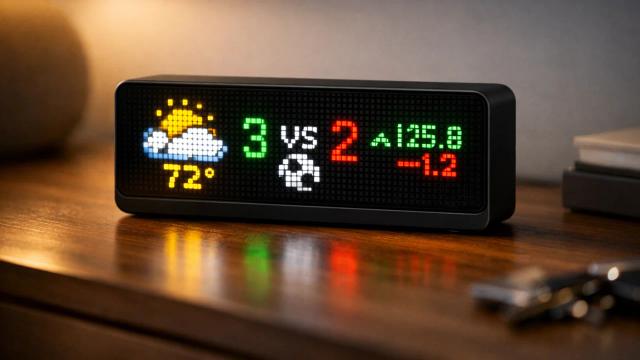
An LED matrix smart display with an optional AI assistant and customizable data connectors - sports, weather, stocks, and more - so you can stay informed without reaching for your phone.
About This Idea
Lumis is a connected LED matrix display that sits on your desk, nightstand, or wall and keeps you informed at a glance. No phone required. It pairs with a companion app that lets you manage "smart connectors": live sports scores, local weather, stock tickers, calendar events, news headlines, and more. Beyond passive data, Lumis features a built - in AI assistant that can answer questions, summarize your day, and surface contextual information when you need it. I'm building Lumis because I lived the problem. I'd pick up my phone to check a score or the weather and 20 minutes later I'd be deep in social media. Lumis breaks that cycle by putting glanceable, ambient information on a dedicated screen with zero distracting apps. What sets Lumis apart from existing smart displays is its open connector ecosystem. Users can add data sources through a no-code builder (drag-and-drop, configure an API, done) or write custom connectors in code for full flexibility. Lumis isn't limited to what I ship -it grows with its community. Think of it as a smart display with its own app store. The hardware starts with accessible, affordable stack: an ESP32 microcontroller driving HUB75 LED matrix panels, with a companion mobile app handling the heavy lifting for AI processing and connector management. Phase one is working prototype and the software platform. Phase two is a polished, consumer-ready enclosure designed and manufactured locally in Kalamazoo.
Where Did This Idea Spark at WMU?
This idea came straight from my daily life as a student. I'm a forth year Computer Engineering major with a minor in Cybersecurity at WMU, and I was constantly battling my own screentime, picking up my phone to check a score or the weather and losing half an hour to mindless scrolling. I wanted a device that could give me the information I needed without the temptation of a full smartphone screen. My coursework in embedded systems, signal processing, and hardware design gave me the technical foundation to actually build it. My internship at AAM taught me real-world engineering discipline and manufacturing awareness. And being involved in WMU's engineering clubs connected me with peers who validated the idea and pushed it forward. Lumis is the intersection of a personal pain point and the skills WMU helped me develop to solve it.
Impact in Kalamazoo
If Lumis succeeded in Kalamazoo, multiple groups win. First WMU engineering and CS students gain a local hardware startup to intern with, contribute to, and learn from - real product development experience that's hard to find in the area. Second, local manufacturers and fabrication shops benefit from prototype and eventually production contracts for enclosures and PCB's. Third the Kalamazoo maker and tech community gets a homegrown product to rally around, reinforcing the city's growing identity as a place where real tech companies are built. Longer term, Lumis's open connector platform creates opportunities for local developers, hobbyists, and even small businesses to build integrations-imagine a Kalamazoo brewery pushing daily tap lists to Lumis displays, or Bell's posting event schedules. The product becomes a piece of local infrastructure, not just a gadget.
How Investment Helps
Funding makes the difference between a breadboard prototype and a real product people can use. My first milestone is building 20 polished beta units and getting them into the hands of WMU students and Kalamazoo community members for real-world testing. That means professional PCB fabrication, injection-molded or 3D-printed enclosures, and reliable LED panels -none of which are possible on a student budget alone. On the software side, investment enables cloud hosting for the connector platform, app store infrastructure, and the AI backend. My first local milestone: a public beta launch event in Kalamazoo with working units, a live connector marketplace, and at least 10 community-built connectors. That’s the proof point that Lumis has a product and a community, not just an idea.
What I'll Do With the Money
Hardware Prototyping - 35%: ESP32 dev boards, HUB75 LED panels, custom PCB fabrication, enclosure prototyping (3D printing and small-batch manufacturing) for 20+ beta units.
Software & Cloud Infrastructure - 30%: Mobile app development tools, cloud hosting for the connector platform and AI backend, API service costs, and app store deployment.
Testing & Beta Program - 20%: Beta unit distribution to WMU students and Kalamazoo testers, user research sessions, iteration on hardware and software based on feedback.
Business & Launch - 15%: Branding and packaging design, beta launch event in Kalamazoo, IP consultation, and initial marketing to build the connector developer community.
About the Founder
I’m Mack Usmanova, a junior Computer Engineering student at WMU with hands-on hardware and embedded systems experience from my internship at AAM and advanced coursework. I’m passionate about building products that solve real problems, starting with my own struggle with phone screen time. I’m combining my engineering skills with Kalamazoo’s maker community to bring Lumis from concept to product.