Pair
Year 1 (2025-26)
by Rallah Cobbins
A wearable ECG monitor paired with a smart home base that alerts families and nearby neighbors during cardiac emergencies.
About This Idea
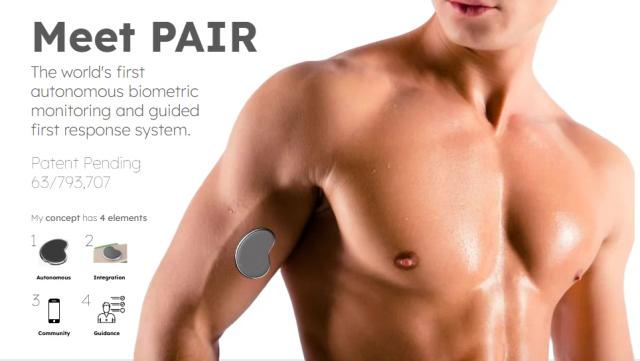
Pair is a wearable ECG monitoring system designed to improve emergency response time during cardiac events.
The system includes:
A non-intrusive wearable ECG device that continuously tracks heart rhythm.
A wireless home base that displays real-time vitals and charges the device.
A neighborhood-connected alert system that notifies nearby trusted users when a cardiac emergency is detected.
Current wearable heart monitors rely heavily on internet connectivity and centralized emergency services. During outages or delays, response time increases. Pair reduces that delay by creating a localized alert network. If the system detects arrhythmia, cardiac arrest patterns, or a fall event, it immediately alerts family members and designated nearby neighbors before EMS arrival.
The device is designed with physical safety in mind — cushioned to reduce injury during falls and embedded with motion sensors to detect kinetic impact. The home base acts as a visible emergency hub, clearly displaying heart rhythm, pulse, and emergency status.
Pair solves one key problem: delayed response during cardiac emergencies in residential neighborhoods.
Where Did This Idea Spark at WMU?
This idea developed through Product Design coursework focused on systems thinking and connected environments. While exploring smart home reliability and offline communication systems, I began researching how health monitoring devices depend heavily on internet infrastructure. That led to questioning: what happens during outages? That gap sparked the concept of a neighborhood-connected ECG system.
Impact in Kalamazoo
If implemented locally, Pair could improve emergency response outcomes for seniors and at-risk residents in Kalamazoo by reducing time-to-intervention during cardiac events. Families gain peace of mind. Assisted living communities gain proactive monitoring. Neighborhoods gain stronger connected care systems.
Beyond safety, Pair introduces a new local job market. Manufacturing, device assembly, system installation, neighborhood network setup, and ongoing technical support all create new roles. As the system scales, Kalamazoo could become an early hub for community-based health technology innovation.
This means:
Local manufacturing partnerships
Certified installation technicians
Health-tech maintenance and monitoring roles
Data and systems management positions
Pair doesn’t just improve safety — it builds a new category of neighborhood-connected health infrastructure, positioning Kalamazoo as a leader in preventative community care.
How Investment Helps
Funding would support building a medically accurate prototype capable of live ECG reading and fall detection testing. It would also allow development of the neighborhood alert communication interface. The first milestone would be testing the system in a controlled residential setting to measure detection accuracy and alert speed. Without funding, it remains conceptual. With funding, it becomes a functioning pilot system.
What I'll Do With the Money
If Awarded $25,000 (Popular Vote)
Advanced ECG hardware integration – $8,000 – Improve medical accuracy and reliability
Prototype refinement & durability testing – $6,000 – Prepare wearable for daily use
Neighborhood alert software development – $7,000 – Build secure local communication system
Pilot testing & data validation – $4,000 – Run local beta program
If Awarded $75,000 (Judges Vote)
Engineering & medical compliance development – $20,000 – Prepare for clinical validation
Small-batch manufacturing setup (local) – $18,000 – Begin Kalamazoo-based production
Software & network infrastructure expansion – $15,000 – Secure, scalable alert system
Hiring technical assistants/installers – $12,000 – Create initial local job roles
Pilot program deployment (multiple sites) – $10,000 – Expand testing across neighborhoods
About the Founder
I design systems that protect people. As a WMU Product Design student, I focus on turning overlooked safety gaps into actionable solutions. Pair was created to reduce cardiac emergency response time and build neighborhood resilience. With rising health risks and aging populations, the moment to act is now.